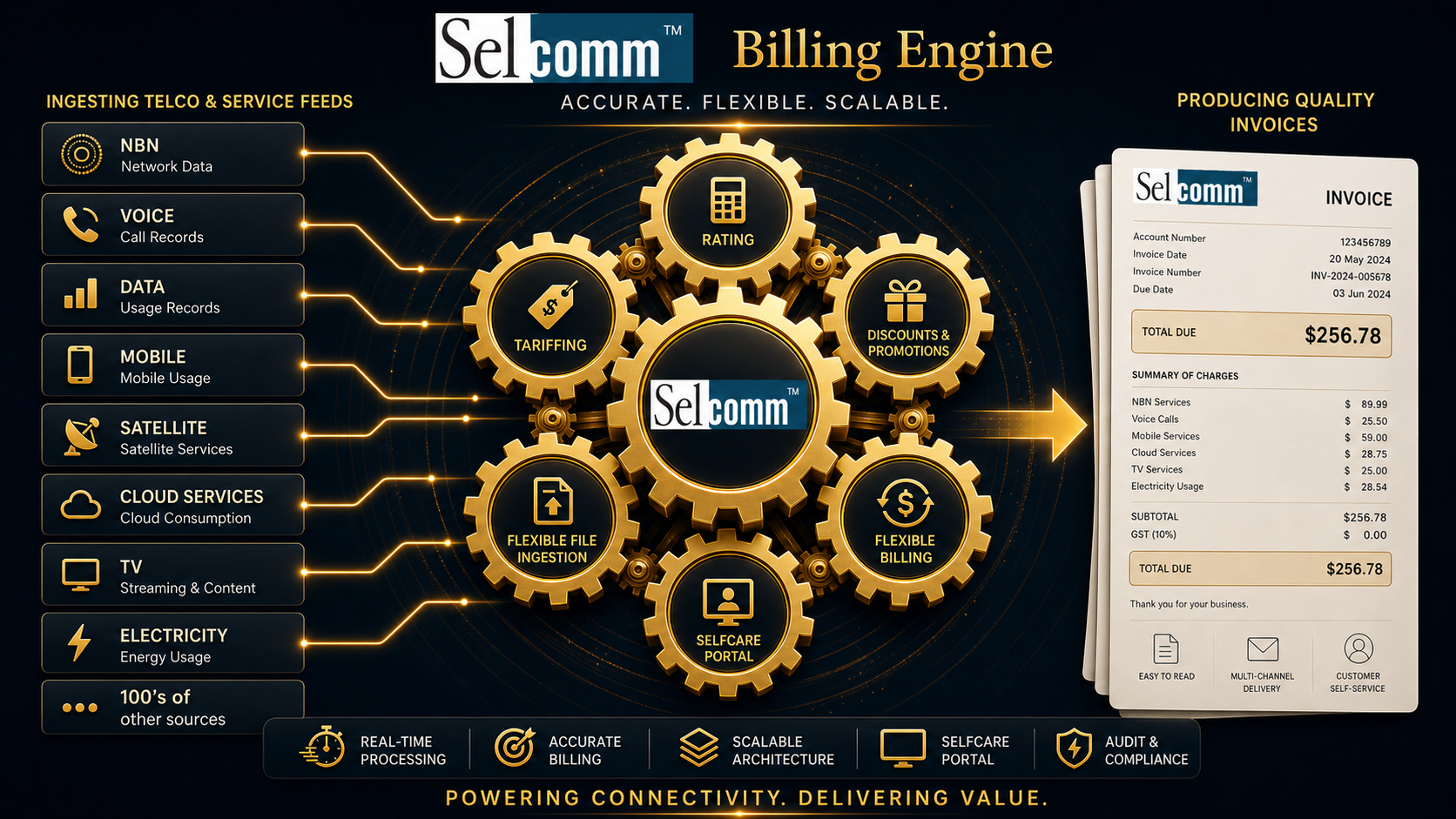
More than an API catalogue
An endpoint is easy to publish. The difficult part is the logic behind it. Selcomm’s web services draw on decades of product development by a team of roughly two dozen developers across rating, tariffing, billing, receivables, customers, products, networks, provisioning, orders, payments and reporting.
These are not empty API shells or code generated for a demonstration. They expose accumulated domain logic, operational behaviour, integration knowledge and production experience. That foundation is difficult to reproduce because it has been shaped by real service-provider requirements and edge cases over many years.
Thousands of web services. Decades of working business logic. One platform your integration team can build on.
Build around the systems you already own
Selcomm does not require every customer experience or operational workflow to live inside one user interface. Your team can combine Selcomm services with in-house platforms, portals, mobile apps, partner systems, data platforms and automation while retaining Selcomm as the trusted commercial and operational engine.
This makes it possible to add new channels and specialised workflows without replacing the customer, service, billing and network foundations already operating in Selcomm.
Functional depth across four integrated modules
Billing
- Rating, tariffing, discounts, bundles, allowances and overages.
- Billing, invoicing, payments, receivables and revenue operations.
- Usage mediation for communications, utility, API, AI and other digital services.
Network
- Data acquisition, validation, reconciliation and mediation.
- Provisioning and service-management workflows across wholesale and network partners.
- Integration of APIs, files, events and operational feeds from external systems.
CRM
- Customer, account, product, service and organisational hierarchies.
- Self-service, ticketing, usage visibility and customer communications.
- Cost-centre and responsibility structures for complex organisations.
Sales & Orders
- Product configuration, quoting, order capture and activation workflows.
- Direct, dealer, partner and white-label channels.
- Contract-specific pricing and the handoff from sale to service and billing.
A stronger foundation for AI-assisted development
AI can generate code quickly. It cannot recreate decades of accumulated billing behaviour, integration knowledge, edge cases and production hardening on demand.
AI development tools are most valuable when they can work with trusted, well-defined capabilities. In the right hands, Selcomm’s service estate gives skilled developers a strong foundation for AI-assisted discovery, orchestration and application development. Teams can use AI to help assemble sophisticated applications around established Selcomm functions instead of asking it to invent the commercial engine beneath them.
Production delivery still requires experienced developers, architecture, permissions, testing and governance. AI is the accelerator; Selcomm’s mature domain capability is the foundation.
Need to bill API or AI usage?
Selcomm’s web-service library gives integration teams a powerful foundation for building applications and connecting systems. Separately, Selcomm can meter and charge for API calls, AI tokens and other digital usage, with attribution to customers, teams, projects and cost centres.
Explore API-call and AI-token billing
Architecture and governance matter
A valuable service estate must be usable safely. Qualified integration work should address authentication, permissions, service discovery, documentation, versioning, auditability, testing and controlled promotion into production.
Not every historical service should automatically be treated as the preferred interface for a new project. Selcomm’s team can help identify the current, supported services and the right design pattern for each application.
Application patterns
- Customer and partner self-service experiences.
- Operational automation and exception workflows.
- Product configuration, ordering and onboarding.
- Usage dashboards, cost-centre views and commercial reporting.
- Integration with in-house CRM, data, finance and operational platforms.
- Specialised applications for telcos, utilities, MSPs, IoT and digital-service providers.